Find out the lessons learned from an expert striker who recently started to grapple.
Most of my training in Martial Arts has been in a striking art: Kyokushin Karate. More than 22 years of training to reach the 3rd dan, an achievement I’m quite proud of.
A few years ago, when I go my first dan, I decided to complement my training with Judo. Let me tell ya, damn!
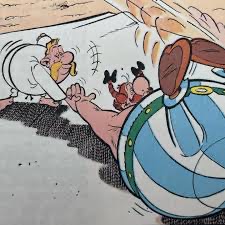
I like to describe Judo as the art of hitting someone with the ground. I felt very much like Obélix when he was fighting with Cilindric, the German Judo player.
I fell hard a few times, which exaserpated some back pain I already had. But when we did groundwork, I didn’t feel that pain. So, I figured Brazilian Jiu Jitsu might be a better match for me.
Not only did the academy I joined was fond of both wrestling and groundwork. Now, I’ve felt like Cilindric when Asterix tricked him into submission.
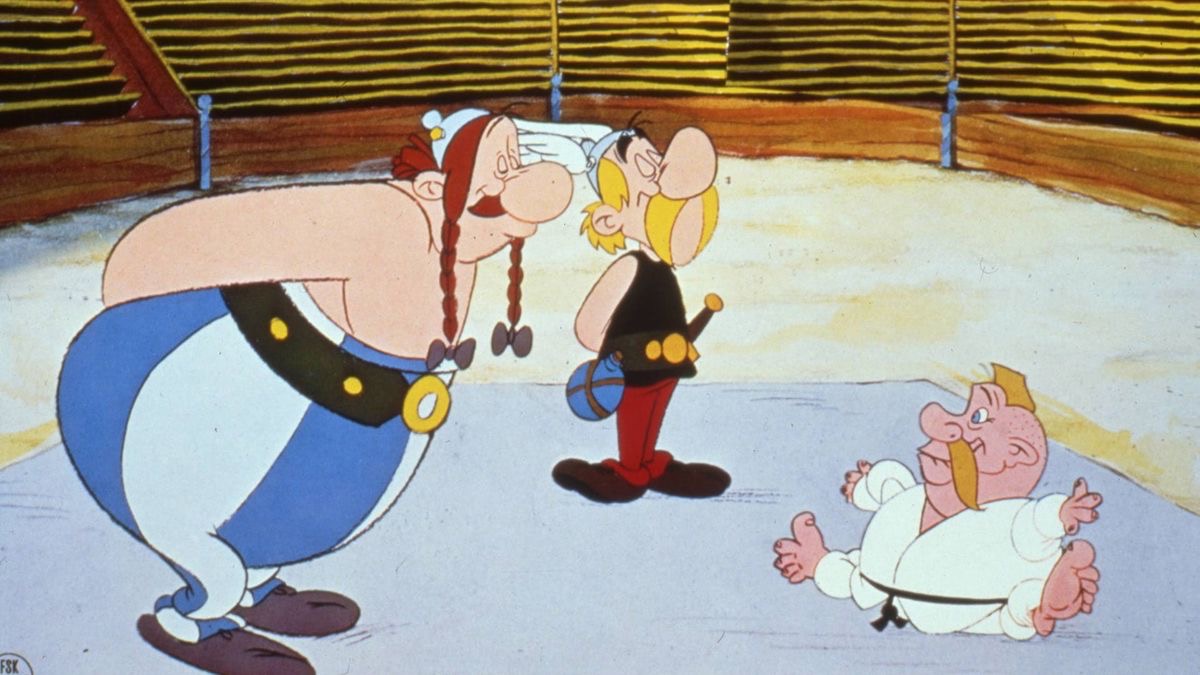
The irony is how Asterix wins by using his wits and this is a key component of BJJ, to outsmart your oponent instead of using pure strength (as Obélix tried to do). I wonder if the authors actually knew that.
Here are the main differences I’ve found so far, after only 1 year of BJJ:
Energy Requirements
When you first learn to strike, it tiring. Mostly a cardio exercise, you start by kicking and punching the air. Then, you’ll move to drills on the pads to then sparring. Unless you plan to compete or fight professionally, this is where you might start losing students. However, for those who stick around, it doesn’t take long to learn how to manage your own energy.
In grappling, you are always with a partner, even when you learning a new technique or drilling. So, depending on who you are partnered with, it could be easy or hard. That being said, because you are working with another body, then training is not only cardio but there is a weight lifting/resistance training component as you always fight against someone else’s body. The amount of resistance can change based on who is your partner, but there is resistance nonetheless. Even during rolls, you never see anyone not sweating and breathing hard, no matter the expertise or belt level.
Lesson #1: always find ways to push yourself and to one way to do so is to add resistance to your training. In Karate, this could be by adding partner drills.
Skill Requirements
Both striking and grappling require skills and strategy. However, because striking requieres you to only control your own body, the numbers of weapons you have is limited to your fists, elbows, knees and feet. Some might even include head butts into the mix. The skill then becomes strategy and agility. Move in ways that you can hit without getting hit yourself.
Grappling has a wider array of techniques and positions. What I found, with my limited training in Judo and BJJ, is that the most skilled players are those that can read the movements of their oponent and essentially predict what they’ll do and counteract because the other person can.
Lesson #2: Add complexity to your training. For Kyokushin, adding a grappling component to the train can do that. Other ways would be to work on strategies, combinations and the like, and then, add pressure.
Safety
When sparring, I find that striking is more dangerous than grappling. During a roll, you can always tap. It’s your safety net. There is no equivalent in striking. You have to hope your partner will be diligent but that it not always the case.
Lesson #3: Safety in the academy is not only the teacher’s responsibility but the students’ too. That needs to be taught and insisted upon in all martial arts academies. Most of us train for fun, only a small percentage go for gold. As such, we need to ensure that safety is on everyone’s mind and to respect your partner when sparring.
Overall Fitness
I’ve been a karate teacher for a while now and rarely found that I exert myself. This is my own fault, of course, but that it also why I decided to take BJJ, to test something new and get my butt handed to me regularily. It increased my overall fitness and I feel overall stronger.
Lesson #4: Add a resistance component to your training. One way or another.
TO CONCLUDE
This post is not to state striking to be lesser than grappling. None at all, but rather share the lessons I’ve learned so far.
What I was pleased to see what that my kyokushin training was quite useful. I know how to move my body, how to ground myself and I am able to stand my ground when grappling. I do not win nor have I been able to tap anyone but still, I’m a tough nut to crack but they do crack me – all the time.
Kyokushin has also helped me develop the mental fortitude to keep going. More on that in a future article.
I still train in both Kyokushin Karate and BJJ, they do complement each other quite well.
Because of what I’ve learned in Judo and BJJ, I decided to add a grappling component to the classes. It will allow us to train harder, develop more skills, make yourself a more complete martial artist and have fun in the process.