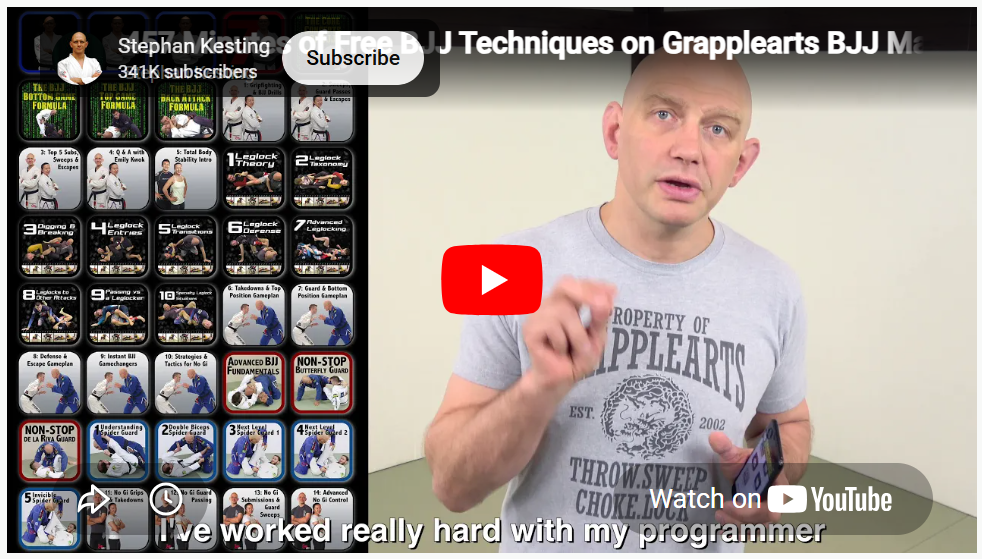
Stefan Kesting is a prominent Martial Arts instructors who has gathered fame over the years as an excellent BJJ and Self-Defense instructor.
I first learned of Mr. Stephan Kesting from a video he did in collaboration with Sensei Ando as I was looking for ways to do the rear naked choke. It was right at the time when I started to focus more on the self-defense aspect of martial arts. Through Sensei Ando’s video, I found both of Stephan’s YouTube channels. One called “Self-Defense Tutorials” which focuses on the combative aspect of Brazilian Jiu-Jitsu (BJJ), where as his other channel “Stephan Kesting” is a BJJ channel.
So, like I do when I discover good info, I go into a binge viewing of all videos on that channel that seem interesting and I ended watching them all. This led me to subscribing to his podcast called the “Strenous Lifetsyle”.
Through all these mediums, this is more of less what I gathered about Stephan Kesting:
I like the fact that he is a father and has a job outside martial arts and although Stephan and I are very different in terms of professional careers, the fact that he has studied in biology and got a master’s degree speaks to his level of knowledge, experience and intellect. He does speak like a scientist, and being an engineer myself, I can relate to the way he speaks and articulates his ideas.
The one thing you’ll notice when you listen to his podcast is that Stephan is very well articulated and poses intelligent questions. All of his podcasts are well prepared, and it shows that he knows his stuff, not only in BJJ techniques, but knows what is going on in the BJJ world, who’s who, etc.
To date, I have listened to 161 of his podcast episodes and viewed pretty much all of his videos on YouTube. I also purchased some of his mobile apps, which have been awesome. I’ll probably do a review of his apps on a subsequent blog post.
Stefan has two formats, the first is interviews, the second are short rants about specific topics. Personally, I’ve enjoyed both.
When I start listening to someone’s podcast, I usually start by listening at the first eposide. I do this because you start seeing how the podcast evolves in the period the podcast has been produced and you start to see how the author starts developing their own philosophies and concepts. Which does he drop and which does he stick to and why.
Here are a few of the concepts that I have learned from him:
Something is better than nothing
When we talk about Martial Arts, it’s very easy to let life get in the way, especially since you have a job outside the art and a family that you actually want to spend time with. This lesson has opened my eyes and my mind to not having to be perfect in my training. I travel quite a bit for work, which is both mentally and physically tiring, and that limits the amount of training I am able to do. I used to be the type to say “never mind, I am too tired!” but then, this little Stephan voice appears in my head saying “something is better than nothing” and that would spark me up to go to the dojo and train, within my own limits and actual conditions and for that, I am grateful for this lesson.
Judo is a high injury risk sport
As I started Judo again a few months back, hearing this from Stephan was disconcerting and a bit discouraging. I’ve really enjoyed Judo so far and I am lucky to train in a dojo where they also do a lot of ground work. So, I’ve decided to heed his advice and just be careful. Tap out early, don’t take risks and just enjoy the training. I am not in it to compete anyway, there is no need to overdo it.
To be effective in martial arts, you need to train against resistance
Stephan was not the first from whom I’ve heard this from, actually a lot of BJJ athletes sing that song. A song that I fully agree with. Training in Kyokushin myself, I understand the value of actually fighting, having an opponent who is looking to bash you in as much as you want to bash them in.
Having said that, the level of resistance can vary, and I believe this is important to not only understand but to implement in your training regimen. Whether you are a competitor or a hobbyist, you can train at different level of resistance, but you need to train under resistance, independently of how low it is. You can get a good and efficient workout by just flowing with your training partner, something I find easier to do in grappling vs striking. Yet, within striking, there are ways to indeed flow at low to moderate resistance and still gain a lot of value from the training.
Grappling is necessary for self-defense
Yes, I agree with that. Now that I’ve trained in Judo for about 2 years, I do see great value in grappling. However, I must say that it is not the only skill you need. You do need to be able to strike (when needed), standup grappling (when needed), throw someone on the floor (when needed) and grapple on the ground (when needed). All these skills, in my opinion, are needed for a well-rounded fighter who is interested in the self-defense aspect of martial arts.
It is because of Stephan that I was motivated to give it serious thought and consideration to training in some kind of grappling art. A back injury has limited that kind of training for now but as soon as I can, BJJ will be my next stop.
To conclude, I highly recommend that you check out Stephan’s work. The information is highly valuable and definitely worth the time. I am adding all of his links below.
Osu!
References: