The following post is to publish the essay I wrote for my Shodan test. I hope you enjoy it. This was back in 2013. Our Sensei assigned us to write an essay that would cover:
Our Kyokushin (Martial Arts) Curriculum
What does it mean to you to become a black belt (Shodan)
An dissertation on the Book of 5 Rings
Published Date: 7th of December, 2013
Curriculum
Yesterday
I believe I started Kyokushin karate back 2000, I don’t remember the actual date to be honest. My karate career started in Montreal, Canada, under Kyokushin Gauthier, a branch of IFK Canada.
My first interest in Karate was because I had a supervisor in my part-time job that used to train kyokushin and he was extremely strong, and my ultimate goal was to become extremely strong. It was an obsession of mine since I suffered from bullying in my teenage years. I soon found out that one of my other colleagues had a dojo and his dad was running it. I therefore decided to join and see what came out of it. Both of them were strong and therefore, the obvious result would be strength. I had no idea what kyokushin was about nor that it existed. In my eyes, karate was karate.
I soon fell in love with the style, the philosophy and the training. I loved the intensity of the training. I was feeling myself getting stronger daily and that obviously translated in other aspects in my life, especially in my own self-confidence. I also started to like kumite, and decided to dedicate more time to training and competing.
I first started in a style of non-contact kumite named “clicker” which consisted in simply marking the technique without touching the opponent. The referees had clickers in their hands awarding points, in a continuous fashion, for each definitive technique. At the time, I didn’t keep track of these things, but I competed only once in this style as a white belt which I won.
I also competed in Kata because our sensei forced us to. He was highly technical and dedicated to the art and his attention to detail I still bring to the table today.
Once I reached my blue belt, I decided to participate in “semi-contact” kumite, which is basically meant that we wore protection: head gear, gloves and shin pads. At the time, our sensei didn’t believe that anyone below 6th kyu was ready for full contact kumite, nor they were allowed in the kumite class. However, after promising my teacher that I would train hard, he allowed me in the class, and he kept a close eye on me for the first class. Once he saw that I could handle it, the real training started! I was 20 or 21 at the time.
Since then, my sempais and I started to train hard, everything we could think of we did, anything we thought was useful we did, anything we saw other champions do, we did, from weight training, to running, to punching bags, to beating each other to a pulp. Anything goes and pretty much anything went.
Since then, I competed in a series of tournament in our own federation as well as others. Anywhere we could fight, we went, ready or not. I won some, lost some, and overall did pretty well for myself without ever really getting seriously injured.
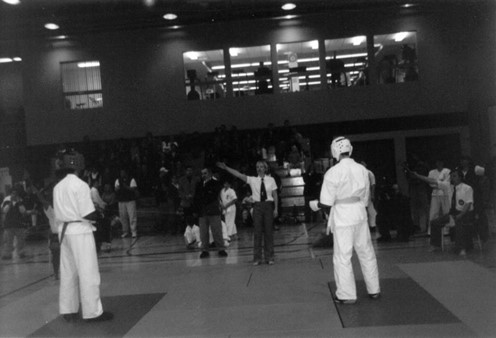
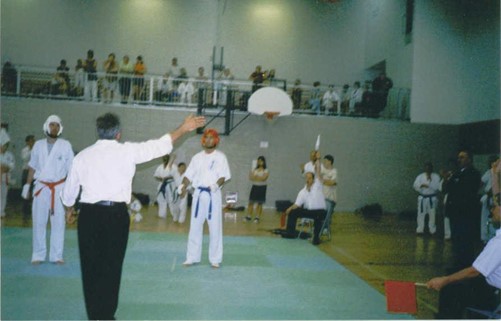
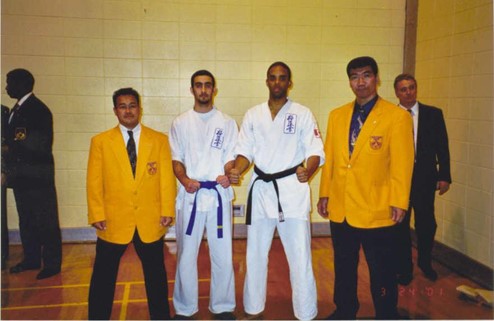
I also participated in summer camps with Shihan Daniel Gauthier, which was such a great experience. Learning from someone with such knowledge is something else and I still remember and value the lessons I learned back then and try to share and transmit them as much as I can. It was also amazing to train alongside national champions and other sempais and senseis from different areas of the country.
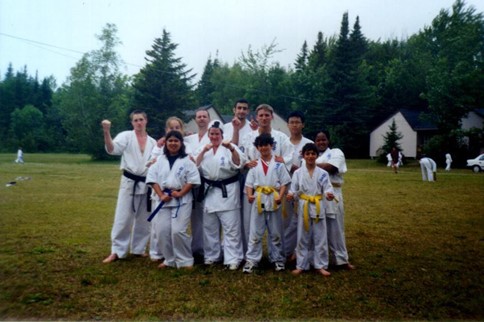
I remember stopping around 2003, I had recently graduated from university and after landing my first job, and my daily 6 hours of public transit back and frorth to work simply killed any training time. I also started to date my, who is to become, wife and that also took time away from training. My Sensei also decided to separate himself with IFK and I didn’t really like where things were going. This pushed me to stop training at the dojo and focus on my career and upcoming family. I had my 7th kyu at the time.
During this time, I continued training on my own, punching the bag from time to time, taken up bodybuilding, and basically continued learning anything about training and fighting, even if I didn’t actually formely trained. In 2007, I moved to Mexico and decided to go back to karate. After searching for one long year, I found Kyokushin Mexico under Shihan Gessi Krame and joined as soon as I could, which was early 2009. I was 7th kyu at the time. I was awarded my 6th kyu with Shihan Krame in 2009.
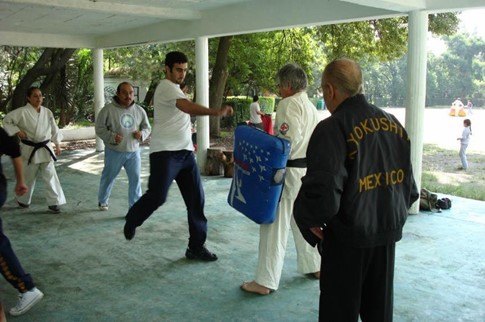
Under Sensei Jacobo Ramirez, Mexican’s Branch Chief, I completed my 2nd and 1st kyu in December of 2011 and 2012 respectively. During that time, I also competed in a dual meet in September 2011 against the fighting team of Toeikan Mexico and competed in april 2013 in Seito Kai Kan, both of which I lost and injured my ribs.
In 2012, under the supervision of Sensei Jacobo Ramirez, I started a small group in the city of Guadalajara, Jalisco. We started with 2 students, one of which left a few months later and another joined us. This last student offered his MMA gym as the unofficial dojo for Kyokushin Guadalajara. We affectionately called our group Nakama Dojo. They continue training to this day.
Today
Arriving to today, I am physically fit, recovered from the different injuries I sustained during the past years and am ready to face this upcoming challenge to earn my shodan and hope to make my teacher and previous teachers proud.
Tomorrow
Independently from the result from the test, my personal goals are to continue growing, both as a person and as a budoka.
Now that I recovered from injury, I plan to work on getting into shape for competition once again, gaining strength, power and speed. My goal is to win the yearly tournament held in Mexico in the black belt category. During this time, I plan to continue my research into learning the ins-outs of competition, considering all aspects: strategy, technique, conditioning and nutrition. I would also like to get certified as a strength and conditioning coach with a specialty in our style of fighting, such that I can assist the younger competitors to get ready for tournaments and reach their goals.
As a karateka, I do plan to continue on this path as long as I can, to continue growing, physically and mentally and be able one day to call myself a sensei or even Shihan if I get the opportunity.
That being said, my goal is to also help in the growth of Kyokushin Mexico. I see this goal can be reach 2 ways: The first is by helping the Mexico City dojo to grow, through smart marketing, demonstrations and word-to-mouth. The second is to do the same with Nakama Dojo in Guadalajara and putting the group on the map, have them assist in yearly events and make them a group to be reckoned with. Also, I have set goals with each student to reach in 2014 and I plan to do whatever I can to help them accomplish these goals.
I would like to help my sensei and sempais in tournaments refereeing, organization and coaching, hopefully one day we can incorporate kata competition in our yearly tournament.
Becoming Shodan
I was first attracted to karate when I was about 7 or 8 years old, when I lived in Saudi Arabia. My dad used to play tennis in a sports club while I trained in karate. I don’t remember much really other than the day I got my yellow belt (subsequent to white) I was so happy to accomplish this goal and how my teacher encouraged me to continue training. Shortly after, we all moved to Canada and my interest in the art slowly disappeared.
Fast forward about 10 years or so, it’s 1998, I’m working as a floor manager in McDonald’s and I meet my new supervisor, a man of average stature, but built like a brick. My thoughts then was that he was a bodybuilder and that his size came from eating a lot and training extremely heavy, something that was of no interest to me at the time. As I learned more about him, I discovered how much strength, power and speed he had. Having suffered from bullying all though secondary school, this definitely caught my attention. Since I skipped a grade, I used to be smaller than my classmates and because of the abuse, I was obsessed about just being immensely strong. Somehow, being strong was going to stop the suffering and they could leave me alone. So, all I had to do was to repeat what my supervisor did in order to get as strong as him… what he did was Kyokushin Karate.
As if the stars aligned for me that day, I discovered that there was a Kyokushin Dojo a few minutes’ walk from my house, owned and operated by the father of another colleague from work, perfect situation. There was no doubt that I had to get in there.
Time to train, time to get strong!
As I started to train in basic techniques, it seemed as if my body was actually fit for karate. Everything I did was strong and powerful and even as a white belt, I was allowed to practice kumite when only yellow belts and up were allowed to fight. I guess my friendship with the Sensei’s son did tip things in my favor.
Suddenly, that childhood dream to have a black belt wasn’t far away. Suddenly, I was stronger, gaining more respect from my friends and foes, and as I grew to my full height and strength, I felt on top of the world. I left the dojo in 2002-3 and my quest for physical strength was reduced to weight lifting and nothing more.
Around that same period, I started my first full time job as a sales engineer and started my relationship with my wife. Training took the side as I focused on building a family and a career. In 2007, I moved to Mexico and I decided to train in Kyokushin again, and this time, to go all the way and get my black belt. I started to train regularly again in 2008 with Kyokushin Mexico.
Now, 2013, the black belt is within reach and thinking about what is being asked of me in this essay made me realize a lot of things.
First, the black belt used to mean that I became an expert, I can beat up anyone anytime, I am extremely strong, etc. Now, I “know”… Right! I know enough to know that I don’t know anything.
Some say that a black belt is simply a white belt who never gave up. That is true.
To me, getting the black belt has become a testament and confirmation of my commitment to Kyokushin Karate. Actually, that’s not totally accurate; the black belt is a confirmation of my commitment to the betterment of myself. As I grew as a karateka in recent years, I began to notice how the way I think and act started to change. I don’t pursue an ultimate goal anymore, for example, getting rich. My focus now is to become simply better, a better person, a better husband, a better father and a better budoka. This is to me, the meaning of true strength.
“Today is victory over yourself of yesterday; tomorrow is your victory over lesser men.”
Miyamoto Musashi
Little did I know that my quest for physical strength turned out to be the quest for inner strength. My body can be frail, old and weak, but my character will remain unshaken, and this is what karate has done for me. It has given me back that old confidence I felt as child all those years ago when I got my yellow belt, which was then stripped away due to bullying and physical and mental abuse. Through training and perseverance, I have found myself again. And now, I am simply going to work on getting better, everyday.
I’ve had a lot of help along the way, from my parents, teachers, friends, coaches, senpais and senseis and their encouragement and unconditional support allowed me to be here today, soon to accomplish this lifelong goal of becoming part of an elite group of karatekas, contemplating the meaning of this achievement for me.
“The ultimate aim of the art of karate lies not in victory or defeat, but in the perfection of the characters of its participants.”
Gichin Funakoshi
The Book of 5 Rings
Written by Miyamoto Musashi in the era of Feudal Japan, the Book of Five Rings took me in a journey of self-discovery and understanding of what martials arts, and by extension life, is all about.
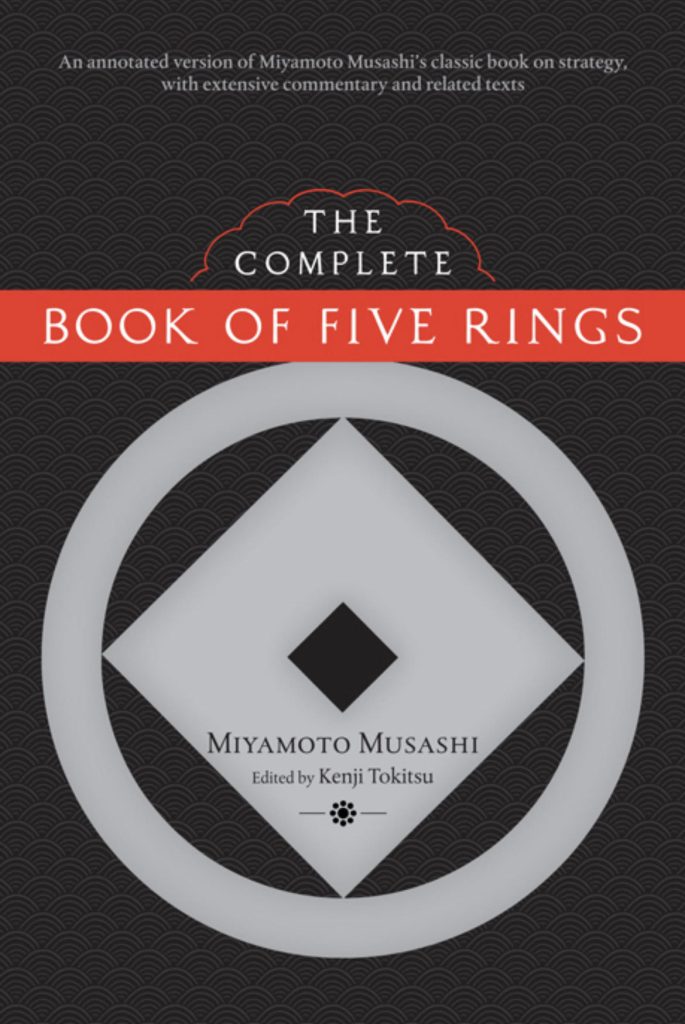
The book of 5 rings is a book of “strategy” that warriors should follow. We can understand strategy to mean a plan or tactic. I believe that what Musashi meant by strategy is mindset, a way of thinking, a way to behave. Musashi does discuss specific techniques of swordfighting but this is a small percentage of the book, he mainly discusses the mindset behind each technique because each technique is not done blindly. He focuses and entices his reader to research, investigate and practice by himself. Through practice will a warrior understand the Way.
“Do or do not, there is no try!”
Master Yoda, Star Wars
Kyokushin has been translated as “Ultimate Truth” and for the longest time, I didn’t understand its meaning. “Truth about what?” was my first reaction when I was told this. Now, I understand that the truth doesn’t reside in some magical technique, or magical potion or philosophy. No, the truth is about hard work, a theme that was repeated several times in the book.
The Ground Book (接地)
“The carpenter uses a master plan of the building, and the Way of strategy is similar in that there is a plan of campaign […] You must practice constantly.” – Musashi
The first book was named the Ground Book and I believe that Musashi decided to use this chapter to set the stage for the rest of the book. He discusses that if a warrior wants to become a master of strategy, he must continuously practice, such as a master carpenter.
He explains that to become a master carpenter, you need to start as a beginner: an apprentice. In order to become a master, then you need to learn from a another master. An apprentice will start with the basics, and through time, he will learn to master these basic skills before moving on to more advanced techniques (such as learning to read architectural and structural plans, how to lay the foundation depending on the terrain, etc) and will eventually become a master carpenter himself.
A master, like a black belt in a martial art or even a teacher or mentor, is simply someone who has more knowledge and more experience than the pupil and is willing to pass on that information.
All through the ages, craftsmen learned their trade through the master/pupil method and nowadays, professionals learn from other professionals, through school and through their supervisors or senior professionals and even mentors. In order to become an expert in any fields, one must practice and gain experience and through the hardships, become an expert.
In relation to martial arts, a student will learn from his teacher(s) and one day, take over and continue the tradition to pass down the information to the next generation. A father will teach his son what he knows so that he can lead a better life.
Although this chapter doesn’t discuss any specific technique, I believe that its message is the most important in the book: start at the beginning and practice, through hard work (the Way), you will become an expert and you will achieve success in your life.
Musashi wrote: “know the smallest things and the biggest things, the shallowest things and the deepest things”, and I believe that the only way to have a broader view on life, is through experimenting and living, practicing, making mistakes and learning from them. Through practice does a warrior learn about himself and his skills and through experience will his skills sharpen and perfect.
The Water Book (水)
Bruce Lee said:
“You must be shapeless, formless, like water. When you pour water in a cup, it becomes the cup. When you pour water in a bottle, it becomes the bottle. When you pour water in a teapot, it becomes the teapot. Water can drip and it can crash. Become like water my friend.”
Similarly, Musashi wrote:
“Water adopts the shape of its receptacle; it is sometimes a trickle and sometimes a wild sea.”
Coincidentally, water has been my field of study and expertise in my professional life. Through my own experience in this field, I can say that water is the perfect metaphor for adaptability, which is what both Musashi and Lee are trying to convey.
“You must think broadly” states Musashi, broadly in the sense of always looking at the big picture and not be stuck on a small detail. By allowing yourself to view the big picture, you can take action and react to whatever comes at you, whether it’s a surprise attack on the field of combat or a problem in a construction site.
In order to achieve this, you need to remain calm and yet firm. A clouded mind, due to fear or excitement, will lead to making the wrong decisions. This is often experienced when we say something while upset or angry and then regretting doing so. Being led by emotions is not the true Way! Only through a calm mind, unflustered by emotions or distractions, can react and adapt to any situation it’s facing.
I believe that this state of calmness can also be called “having a clear mind”, free of distractions and focusing on the task at hand. I believe this is also called mushin. It is said that only highly trained martial artists can reach this state of mind, but I disagree. I would say that only highly trained individual can attain this state willingly. I believe we all have experienced this state of mind one way or another without even realizing it. Nowadays, sports psychology refers to it as “flow state”, or “being in the zone”, where athletes in sports events seem unstoppable, but I’ve experienced this while studying and at work. Have you ever been so focused and feel completely productive then suddenly, a small knock on the door or even a phone call disturbs you and you lose your concentration? Then in those instances, I believe you have attained mushin.
This also happens when in time of crisis, instead of panicking, one suddenly is clear on exactly what to do. No emotions interrupt their thoughts; they just do what they need to do. Emergency response personnel (policemen, firemen) know this very well. If you think too much, they won’t face these life threatening situations.
The key is to be able to achieve the steadiness of the mind willingly requires practice. There is no other way to do so. Through steadiness of mind, one can begin to flow like. This is expressed in the book when Musashi talks about stance, gaze, footwork etc. nothing he explains is set in stone and this cannot be clearer when he explains the different attitudes. None of these attitudes (or guard positions) are fixed, there is no one right way to do things, they all depend on whatever the opponent does, hence adapting the stance and strategy of attack, through a clear mind, according to the circumstances.
“Fixedness means a dead hand. Pliability is a living hand”, such as water. Water is never the same, takes many shapes, adapts to the conditions of temperature and pressure and because of that, water is alive… water is life!
The Fire Book (火)
The fire book is all about fighting, in the world of karate, it would be all about kumite. Kyokushin practitioners are very knowledgeable in the art of hand-to-hand combat and this section of the book is about just that.
I believe this section is quite clear in its message: to be proficient at fighting, frequent and continuous training and practice is required.
Nowadays, we would say that the way to become an expert and proficient in kumite, the practitioner needs to continuously train and practice in the dojo and then, through challenges faced in tournaments and such events, they can test their skills to then continue perfecting them.
“A man who wants to master the essence of my strategy must research diligently, training morning and evening. Thus can he polish his skill, become free from self, and realize extraordinary ability. He will come to possess miraculous power. This is the practical result of strategy.”
Mushashi
The rest of the Fire Book, the autor discusses different tactics, from timing, to studying the land, etc. however I really enjoyed the part where we mentions how to use his mind and energy to influence your enemy. This is stronger than simply being physically stronger or faster, it become a battle of will’s, the strongest will will result as the victor.
I often experienced this where fear and anxiety will control my mind and instead of sticking to the fight plan before a tournament, I had already lost before even stepping up to the mat. I’ve also seen many fights were it was easy to predict the result just by the way the competitors state of mind, which is reflected in the way they stand and walk. A fear stricken fighter is easily detectable and once you allow fear to take a hold of your spirit, it is very difficult to overcome it.
One can master one kick, one punch and one throwdown, or one can learn an array of strikes and grappling techniques, however, if your mind is not trained to control itself. Once you become the master of your mind can you really apply all these tactics explained in the book.
“…Think of karate as a language – the Kihon can be thought of as the letters of the alphabet, the Kata will be the equivalent of words and sentences, and the Kumite will be analogous to conversations.”
Mas Oyama
The Wind Book (風)
The third section of the book discusses the way other schools teach their Way. According to Musashi, none are correct because they focus on one strategy; let it be the very long sword, or only the small sword, some teach specific footwork, others on fixing the eyes in a specific way, etc.
None, however, teach the right mindset to fight, maybe because these teachers don’t have the knowledge to teach it, instead they focus on “special techniques” to show themselves as experts.
“In my doctrine, I dislike preconceived, narrow spirit”
Miyamoto Musashi
This is often shown in martial arts movies, where one fighter would brag his special technique and another is argues that his technique is best, only to lead to the inevitable duel between these two.
“The Spirit of my School is to win through the wisdom of strategy, paying no attention to trifles”
Miyamoto Musashi
Indeed, there is no right fancy technique to fighting, but only a correct mindset (strategy). However, a fight involves one or more opponents. So, training properly is only half of the equation, the other half concerns whomever you are facing. So, in order to be really ready for any eventuality and not be taken by surprise, you need to learn the ways of other schools and other martial arts. This will give the fighter the insight and experience to size an opponent and establish a strategy to win.
I’d be so bold to say that as warriors, we also need to study how criminals think and operate. This doesn’t need to be applicable only on the mat. The reason is because we need to train in order to be able to handle any type of attack that we might encounter.
This can also be applied to the business world, where a business owner also needs to study their competition, direct and indirect, in order to strategize and be able to place his business in the marketplace and become successful.
The Book of the Void (空所)
“To attain the Way of Strategy as a warrior you must study fully other martial arts and not deviate even a little from the Way of the warrior. With your spirit settled, accumulate practice day by day, and hour by hour. Polish the twofold spirit heart and mind, and sharpen the twofold gaze perception and sight. When your spirit is not the least clouded, when the clouds of bewilderment clear away, there is the true void.”
Myamoto Musashi
I believe this quote summarizes the book perfectly. I understand it this way:
“Know and study the situation in front of you, let it be a problem at work, a situation with your children or an opponent on the mat, allow your training to come through to find a way to solve it, do not allow any judgement or emotion to cloud your mind such that you keep seeing the big picture and then act.”
This philosophy has become my way of solving problems and the way I generally lead my life. I try not to let judgement influence my action. I try to flush away any negative thoughts and clear my head such that I can study the problem at hand and through the study, be able to find a resolution, and then act upon it.
I once read that one mixed martial artist said that his ultimate goal was to have the perfect fight: to be completely void of any emotions, to fight with clear, undisturbed mind, see the fight for what it truly is. In other words, reach the void and attain the Way of strategy.
Five Rings of Self-Discovery
In order to better understand why Sosai Oyama used this book as a source of inspiration to develop and create Kyokushin, I had to understand Sosai a little better. Since I don’t have access to him, I decided to read testimonials of different kyokushin practitionners who had trained with him to try and get an insight on who Sosai Oyama was.
My first inkling of Sosai’s philosophy came to me from a comment that Shihan Daniel Gauthier, from IFK Canada, told us in Summer Camp: “I remember we did a seminar with Sosai and we did Takioku Sono Ichi for the duration of the seminar! We did it over, over and over again…” At the time, I didn’t think much of his comment, being “new” at Karate and barely understanding what this meant.
The second realization came through my Supervisor, Senpai Ian, who used to tell me “stop thinking, just do it, you’ll understand later!” when he would give me a task that I didn’t want to do or didn’t understand why it had to be done. Obviously, understanding did come once I saw the results achieved.
The third hint I got was through my recent research, I fell on a book written by Sensei Nicholas Pettas, who was one of the last Ushi Deshi who trained under Sosai. In his book, Sensei Nicholas mentioned how Sosai was, in general, a simple man, who dedicated his clases to the repetition of specific technique and/or kata, meaning that – as Shihan Daniel said – that they would do the same technique for the during of the class, whatever the technique was.
This goes hand in hand with what Musashi kept on advising in his book: “you must practice this well” or “you must study this” or “you must research this”.
In other words, in order to understand a particular technique, or strategy, one had to do, study and practice, and through this study came understanding, with understanding came clarity of mind. Through clarity of mind came confidence.
I can therefore summarize why Sosai used this book as his main source of inspiration in one term: self- discovery.
Through repetitive and continuous practice, one can learn and understand how the technique works for himself, when to use it, how to use it, and basically, program yourself in using said technique without really thinking about it. The continuous practice becomes the study of the technique.
To develop his karate, I believe that Sosai had to understand himself and then his art and this could only be done through rigorous and repetitive practice such that he embodies each technique as his own.
Conclusion
As I am finishing this essay, I believe that the overall theme is perseverance. Through hard work and continuous training, success is reach.
I made several parallels between martial arts and normal daily life. It is not uncommon to see that Kyokushin practitioners become successful in their lives and that main lesson of never giving up can be applied in all areas of our lives.
This is reflected in the term OSU, or Osu no Seishin: to persevere, to endure the hardships.
Karate used to be all about fighting to me. Not anymore. Many say that karate is a way of life. I would say that karate, at his core, is a way to lead a life.
Sensei Pettas said in his book2:
“Sosai wanted us to become men of a certain kind, the kind of men that young people would grow up to admire and who would, one day, be able to lead other mean.”
There is no mention here that Sosai wanted to create fighters, but men, or gentlemen to be exact. A gentleman understands the value of hard work, is respectable and successful.
My final thoughts are that in order to become a leader of men and achieve success, one must have a steady mind, maintain a live spirit and studious mind to continuously learn and improve. Through this acquired knowledge, apply and practice it, through this experience, you will gain even more knowledge and eventually become successful. Success is a state of mind.
Osu!
References
Kaufman, Steve, and Musashi Miyamoto. Musashi’s Book of Five Rings: The Definitive Interpretation of Miyamoto Musashi’s Classic Book of Strategy. Boston: Tuttle Pub, 2004.
Pettas, Nicholas. Blue Eyed Samurai: 1000 Days in the Young Lions Dormitory. Place of publication not identified: Global Friends Communications Co. Ltd., 2011.